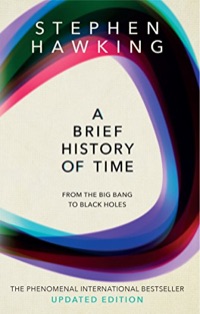
 A Brief History of Time
Score Classic
What it's about
Stephen Hawking's attempt to explain the biggest questions in physics to ordinary readers: where the universe came from, how it might end, what black holes are, why time only moves forward, and whether physics can ever find a single theory of everything. He takes readers from Newton and Einstein through the big bang, quantum mechanics and his own discoveries about black holes, with only one equation.
Why it's worth reading
It's one of the best-selling science books ever because Hawking makes mind-expanding ideas feel within reach, with wit and wonder. It's the classic starting point for anyone curious about the universe.
You'll love it if you liked
 Cosmos
 Gödel, Escher, Bach: An Eternal Golden Braid
 The Making of the Atomic Bomb
Good to know
It's short, about 250 pages, but some middle chapters on quantum physics get abstract; it's fine to read them lightly. Some science has moved on since 1988.
By the numbers
- Readers79 out of 100 · counts 42%
- Critics80 out of 100 · counts 14%
- Bestseller89 out of 100 · counts 34% (its stronger lane)
- Buzz0 out of 100 · counts 10%
Critics and Bestseller are two ways to earn a place: a book's stronger one counts more. Buzz rewards recent bestseller weeks and prizes, so older books start at zero. The parts combine into the Must-Read Score, shown on a scale where the best book we found scores 99 and the last book to make the ranking scores 50.
Where it ranks
- #3 of the 119 science and ideas books we rank
- #7 of the 198 history books we rank
- #11 of the 762 classics we rank
- #40 of the 2,816 books we rank
Why it made the list
Reads as
True story, Thought-provoking
If you like this, read next
 The Lord of the Rings
 The Right Stuff
 And the Band Played On: Politics, People, and the AIDS Epidemic
 The Mismeasure of Man
 The Structure of Scientific Revolutions
 On the Origin of Species
Explore the best-of lists
All 36 best-of lists →









Quick answers
Is A Brief History of Time worth reading?
Yes. It's one of the best-selling science books ever because Hawking makes mind-expanding ideas feel within reach, with wit and wonder. It ranks #40 of the 2,816 books in our ranking, with a Must-Read Score of 89.6 (the best book we found scores 99).
What is A Brief History of Time about?
Stephen Hawking's attempt to explain the biggest questions in physics to ordinary readers: where the universe came from, how it might end, what black holes are, why time only moves forward, and whether physics can ever find a single theory of everything. He takes readers from Newton and Einstein through the big bang, quantum mechanics and his own discoveries about black holes, with only one equation.
How long does it take to read A Brief History of Time?
About 6 hours (240 pages), or about 2 weeks at 30 minutes a day.
What should I read after A Brief History of Time?
If you liked it, try Cosmos by Carl Sagan, Gödel, Escher, Bach: An Eternal Golden Braid by Douglas Hofstadter or The Making of the Atomic Bomb by Richard Rhodes.