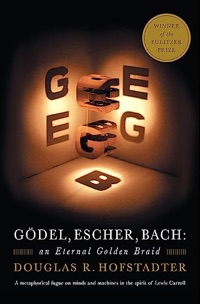
 Gödel, Escher, Bach: An Eternal Golden Braid
Score Classic
What it's about
What does a mathematician's proof, a printmaker's impossible staircases and a composer's endlessly rising canons have in common? Douglas Hofstadter uses Gödel, Escher and Bach to explore how meaning and self-awareness can arise from systems of rules, from formal logic to DNA to the brain, asking how a mind can emerge from mere matter. Chapters alternate with playful dialogues between Achilles and the Tortoise.
Why it's worth reading
It's one of the most original books ever written, a playful, mind-bending work that won the Pulitzer Prize and has inspired generations of scientists and thinkers. It rewards curious, patient readers enormously.
You'll love it if you liked
 Cosmos
 A Brief History of Time
 The Structure of Scientific Revolutions
Good to know
It's demanding: nearly 800 pages, with logic and number theory. No advanced math is required, but expect to work. Many readers take months and call it life-changing.
By the numbers
- Readers89 out of 100 · counts 42%
- Critics95 out of 100 · counts 34% (its stronger lane)
- Bestseller30 out of 100 · counts 14%
- Buzz0 out of 100 · counts 10%
Critics and Bestseller are two ways to earn a place: a book's stronger one counts more. Buzz rewards recent bestseller weeks and prizes, so older books start at zero. The parts combine into the Must-Read Score, shown on a scale where the best book we found scores 99 and the last book to make the ranking scores 50.
Where it ranks
Why it made the list
Reads as
Thought-provoking, True story
If you like this, read next
 The Lord of the Rings
 The Right Stuff
 Sophie's Choice
 And the Band Played On: Politics, People, and the AIDS Epidemic
 Foundation
 Ficciones
Explore the best-of lists
All 36 best-of lists →








Quick answers
Is Gödel, Escher, Bach: An Eternal Golden Braid worth reading?
Yes. It's one of the most original books ever written, a playful, mind-bending work that won the Pulitzer Prize and has inspired generations of scientists and thinkers. It ranks #52 of the 2,816 books in our ranking, with a Must-Read Score of 88.9 (the best book we found scores 99).
What is Gödel, Escher, Bach: An Eternal Golden Braid about?
What does a mathematician's proof, a printmaker's impossible staircases and a composer's endlessly rising canons have in common? Douglas Hofstadter uses Gödel, Escher and Bach to explore how meaning and self-awareness can arise from systems of rules, from formal logic to DNA to the brain, asking how a mind can emerge from mere matter. Chapters alternate with playful dialogues between Achilles and the Tortoise.
How long does it take to read Gödel, Escher, Bach: An Eternal Golden Braid?
About 8 hours (314 pages), or about 2 weeks at 30 minutes a day.
What awards has Gödel, Escher, Bach: An Eternal Golden Braid won?
Pulitzer Prize (General Nonfiction) winner (1980); National Book Award (Nonfiction) winner (1980).
What should I read after Gödel, Escher, Bach: An Eternal Golden Braid?
If you liked it, try Cosmos by Carl Sagan, A Brief History of Time by Stephen Hawking or The Structure of Scientific Revolutions by Thomas S. Kuhn.